

An unrestrained dog in a moving car is a projectile with fur. In a sudden stop at highway speed, the physics are ugly: a 40 lb dog carries forward momentum that no collar, no back seat and no driver reflex can absorb safely. The best dog car harnesses for road trips solve that in one clean move, routing the seat belt across the chest and shoulders instead of the neck, exactly the way a human belt works.
Our top pick is the Kurgo Enhanced Strength Tru-Fit, and the reason is not marketing. It is the only stand-alone full harness in the roundup: no separate tether or clip to attach, and no manufacturer instructions to follow at a rest stop. It is also the only one built around all-steel hardware with five points of adjustment. For a driver covering six hours in a row, that combination matters more than any feature printed on a listing.
We spent weeks going through the top-rated dog car harness options on the market, comparing construction, adjustment range, hardware, and what owners actually say after a long drive. One thing became clear early, and it shapes everything below: most products sold as dog car harnesses are tethers, not harnesses. They are elastic straps with a clip on one end that loop into a seat belt buckle and a D-ring on the other. They work as well as a decent tether can, but they depend on the dog already wearing a well-fitted walking harness. Only two of the twelve products here are wearable harnesses. We flag that for every entry so you know exactly what you are buying.
Most guides we read cover general car safety and stop there. Road trips raise different questions: comfort across six hours, chafing under the chest, break cadence, heat, and what to do when your dog is a 90 lb Lab who cannot ride in a carrier. If you also carry outdoor gear, our picks for binocular harnesses for hiking and climbing harnesses cover the gear side of the same problem.
Table of Contents
- Top 3 Dog Car Harnesses for Road Trips in 2026
- All 12 Dog Car Restraints at a Glance in 2026
- 1. Kurgo Enhanced Strength Tru-Fit – the only real harness here with steel hardware
- 2. Active Pets Car Seat Belt – a top-rated swivel restraint for small dogs
- 3. SlowTon Headrest Seat Belt Two-Pack – lockable, reflective, one per car
- 4. COOYOO Dog Seat Belt – the budget tether with the most reviews
- 5. Lukovee Harness and Tether Set – the mesh vest for hot-weather driving
- 6. Mighty Paw Seat Belt with Aviation Aluminum Carabiner
- 7. laqibak 3-in-1 Seat Belt – the most flexible mounting options
- 8. Mi Metty Coated Wire Seat Belt – the pick for heavy chewers
- 9. IOKHEIRA Aviation Aluminum Belt – the longest adjustment range
- 10. IOKHEIRA Locking 3-in-1 Belt – the strongest published tensile figure
- 11. PUEENOD Two-Pack Seat Belt – the reflective budget pair
- 12. PAWBEE Stainless Hook Two-Pack – the simple multi-car option
- How to Choose a Dog Car Harness That Survives a Long Drive
- Frequently Asked Questions
- Which Dog Car Harness to Pack for Your Next Road Trip
Top 3 Dog Car Harnesses for Road Trips in 2026

Kurgo Enhanced Strength Tru-Fit
- All-steel buckles
- Five point adjustment
- Padded chest plate
- Lifetime warranty

SlowTon Headrest Belt Two-Pack
- Lockable quick-release shackles
- Two belts included
- Reflective stitching
All 12 Dog Car Restraints at a Glance in 2026
The table below lists every restraint we tested in this roundup in the order we rank them, with the hardware and attachment style that decide whether it suits a long drive. Check the connection column first: if it says harness D-ring, you need a separate walking harness to use it.
| Product | Specs | Action |
|---|---|---|
| Kurgo Enhanced Strength Tru-Fit |
|
Check Latest Price |
 Active Pets Car Seat Belt Active Pets Car Seat Belt |
|
Check Latest Price |
| SlowTon Headrest Belt Two-Pack |
|
Check Latest Price |
 COOYOO Dog Seat Belt COOYOO Dog Seat Belt |
|
Check Latest Price |
 Lukovee Harness and Tether Set Lukovee Harness and Tether Set |
|
Check Latest Price |
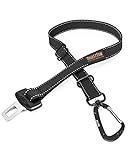 Mighty Paw Aluminum Carabiner Belt Mighty Paw Aluminum Carabiner Belt |
|
Check Latest Price |
 laqibak 3-in-1 Seat Belt laqibak 3-in-1 Seat Belt |
|
Check Latest Price |
 Mi Metty Coated Wire Belt Mi Metty Coated Wire Belt |
|
Check Latest Price |
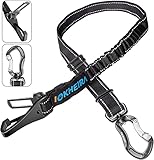 IOKHEIRA Aluminum Carabiner Belt IOKHEIRA Aluminum Carabiner Belt |
|
Check Latest Price |
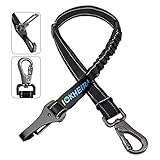 IOKHEIRA Locking 3-in-1 Belt IOKHEIRA Locking 3-in-1 Belt |
|
Check Latest Price |
 PUEENOD Two-Pack Seat Belt PUEENOD Two-Pack Seat Belt |
|
Check Latest Price |
 PAWBEE Stainless Hook Two-Pack PAWBEE Stainless Hook Two-Pack |
|
Check Latest Price |
1. Kurgo Enhanced Strength Tru-Fit – the only real harness here with steel hardware
Kurgo Enhanced Strength Tru-Fit Dog Car Harness – Pet Travel Safety Harness – Crash Test Certified Fit – Five Point Adjustment – Secure Buckle – Padded Chest – Ink Blue – Medium
All-steel buckles
Five point adjustment
Padded chest plate
Lifetime warranty
Pros
- Only full body harness in the roundup
- All-steel hardware holds its setting
- Five points of adjustment fit deep chests
- Doubles as a walk harness
Cons
- Tension latch is fiddly to fasten
- Heavier than plastic buckle rivals
- Chest plate padding is light
This is the harness to buy if your dog is a deep-chested breed that most generic harnesses swallow: a Labrador, a Rottweiler, a standard poodle. Five points of adjustment across the chest and body let you get the fit tight enough that the load goes through the structure rather than through loose webbing, and the all-steel buckles stay where you put them instead of creeping under hard braking.
Owners treat it as the reference travel harness for a reason. Across thousands of reviews, the steel hardware and multi-point adjustability are the two things people single out, and the fit holds on dogs far heavier than the listing size chart suggests.
There is one real drawback, and it is worth knowing before a long trip. The tension-style latch takes two hands and some practice, and it can work loose if the harness is not fitted very tight. Budget five extra minutes for the first fitting of the trip, tighten every strap, then check the latch twice before you turn the key.
The chest plate is padded but not plush, so on a dog who rubs against seat fabric, a thin shirt under the harness is a sensible long-drive precaution. It weighs just over a pound, which is noticeably heavier than the nylon tethers below, and in summer heat that extra metal is the thing you will feel.
Why we picked it for multi-hour drives
Because it is a harness the dog simply wears, with the seat belt threading through it, rather than a strap clipped to a D-ring or a carabiner at the seat. Load spreads across a padded chest and shoulders. Over a long journey that difference is the difference between a dog that sleeps and a dog that spends six hours shifting position.
The front leash ring also pulls the harness to one side when used on a walk, which is a real annoyance on leash walks but irrelevant once the dog is belted in.
Where it falls short
Sighthounds are the classic problem fit. Greyhounds, Whippets and Salukis have deep narrow chests and very little tissue over the sternum, and no crash-tested harness in this category adjusts for that narrow profile well. If you own one, skip to the crate discussion in the buying guide.
It is also a Medium size listing, so check your dog against the chest girth chart before ordering. For giant breeds above roughly 110 lb, credible harnesses in this category simply do not exist yet.
2. Active Pets Car Seat Belt – a top-rated swivel restraint for small dogs
Active Pets Black Car Seat Belt for Dogs, Attaches to Harness & Collar, Adjustable 18″ – 24″ Travel Restraint System Fits Small – Large Pups for Safety & Comfort, Essential Pet Supplies & Accessories
360 degree swivel
Zinc alloy hardware
18 to 24 inch range
Universal vehicle fit
Pros
- 4.7 average across 8733 reviews
- Swivel stops tangling and lets dog reposition
- Installs in seconds in any vehicle
Cons
- Short 18 to 24 inch range
- Collar attachment less safe than harness
- Less engineering detail than metal rivals
A 4.7 average across 8733 reviews is among the highest ratings in this group, and it comes from simplicity rather than engineering depth. The whole system is a nylon strap with a 360-degree rotating clasp, and that swivel is the feature owners praise: the dog can stand, turn, lie down or face the window without the strap winding up into a twist.
That matters more on a road trip than you might expect. Tangles are a named frustration among owners who have driven long distances, and a twisted strap on a moving dog is a strap that is not doing its job.
It attaches to a harness or a collar, and harness is the connection you want. A collar attachment concentrates the same force across the trachea that a crash-tested design exists to avoid.
The listed adjustment range is 18 to 24 inches, one of the shortest spans of the tethers here and tight in a large back seat. Measure from the anchor point to where the D-ring sits on your dog before you commit.
Best for dogs under 25 pounds
Small dogs are where this design is at its best. The light 3.2 ounce strap and short adjustment span suit a dog that would rather sit on the seat than curl in a carrier, and the swivel lets small breeds reposition constantly without tangling.
For a small dog who is carsick, the ability to lie down flat while restrained usually settles them faster than a rigid carrier does.
What to watch out for
Zinc alloy hardware is fine but it is not steel, and the listing carries less technical specification than the metal-hardware rivals. If your dog is a powerful chewer, the strap, not the clip, is the weak point.
In a sedan with a large back seat, the range runs out before the dog does. The same belt in a compact hatchback is a comfortable fit.
3. SlowTon Headrest Seat Belt Two-Pack – lockable, reflective, one per car
SlowTon Dog Seat Belt for Car, 2 Pack Dog Car Harness Seatbelt with Bungee
Lockable quick-release shackles
Two belts per pack
20 to 27 inch range
Reflective stitching
Pros
- Lockable shackles stop a dog popping the clip
- Two belts cover two cars or two dogs
- Reflective stitching helps night driving
Cons
- Headrest loop needs exposed posts
- Detaches as a leash
- Attach to harness not collar
The SlowTon set is the only restraint here built around lockable quick-release shackles at the vehicle end. That single design choice answers the most common failure in this category: a dog that reaches back and pops the connection free the moment you hit a stop. The shackle holds, and the elastic section absorbs the jerk before your dog feels it.
You get two belts in the pack, which turns a single-strap purchase into a two-car or two-dog solution. The adjustment runs 20 to 27 inches and stretches to 32, with reflective stitching along the webbing for early morning and night departures.
The mounting point is the headrest, looped around the posts with a quick-release shackle. If your headrests are permanently fixed to the seat back with no exposed posts, this design will not work and you need a seat belt buckle model instead. Check before you order.
It also detaches to work as a plain walking leash at full extension, which is a nice extra, though owners are reminded to clip into a harness rather than a collar.
Best for night driving and two-dog households
Reflective stitching is not decoration on a 6 a.m. departure in fog. It makes the dog visible through the rear window at service stations and rest stops, and the second belt in the pack means a two-dog car can both be restrained properly instead of one riding loose.
The lockable shackle also makes this the tether we would trust most for a dog who has learned to work its way out of a clip.
What about the connection to the dog
It still attaches to a harness, and the elastic buffer means this is a comfort and anti-tangle device as much as a restraint. The headrest loop, not the belt, is what takes the load, and that is the point.
Expect to re-check the loop tension at every stop. Webbing settles over hours, and a headrest loop that slackens by half an inch every two hundred miles is doing less than it did at mile zero.
4. COOYOO Dog Seat Belt – the budget tether with the most reviews
COOYOO Dog Seat Belt, Durability Retractable Dog Car Harness Adjustable Dog Seat Belt for Vehicle Nylon Pet Safety Seat Belts Heavy Duty & Elastic (1 Pack Black)
Heavy duty nylon webbing
Elastic buffer
360 degree aluminum clasp
24 to 31 inch range
Pros
- Elastic buffer absorbs potholes and hard braking
- Swivel clasp prevents tangling
- Soft washable nylon
Cons
- Not a stand-alone harness
- Occasional clip seating failures
- 31 inch max is short in large vehicles
With 37505 reviews at 4.6, this is the most examined budget tether in the category and it earns that volume. The elastic bungee section is the reason owners keep it: instead of yanking the dog the instant you brake, it stretches and gives, which matters far more on a rough road than on a smooth highway.
The 360-degree swivel clasp is machined from aluminum alloy and rotates freely, so the strap does not wind when your dog changes position. Nylon construction is soft and washable, which on a six-hour trip with a shedding dog is not a small thing.
Understand what you are buying: this attaches to a harness D-ring, so you need a properly fitted walking harness already. It is the least expensive way to add restraint to an existing harness, not a replacement for one.
One owner reported a seat belt clip that would not stay seated in the buckle. Check the click into the receptacle every time you get in the vehicle, and do not drive with a connection you have not confirmed by hand.
Why it works for long drives
The bungee buffer is a comfort feature as much as a safety one. Dogs settle faster when braking is cushioned, and a settled dog is a dog who sleeps through a six-hour stretch instead of pacing the footwell.
It weighs 3.21 ounces and adds almost nothing to your load, which matters if you are packing for two people and a dog.
Where it falls short
The maximum of 31 inches is genuinely short in a large SUV or wagon. And the elastic design that makes it comfortable also means it stretches, so a small dog who lunges toward a door can reach further than the listed length suggests.
Owners planning multi-leg trips should treat it as a stop-and-check item, re-seating the buckle at every fuel break.
5. Lukovee Harness and Tether Set – the mesh vest for hot-weather driving
Lukovee Dog Car Harness Seat Belt Set, Seatbelt with 2 in 1 Buckle, L
Breathable mesh chest vest
Reflective tether 20.9 to 29.1 inch
Two connection options
Four adjustment points
Pros
- Only complete vest and tether set in the roundup
- Double layer mesh stays cool and limits chafing
- Works as both walking harness and restraint
Cons
- Lowest average rating in the set
- Bulkier than a strap only design
- Requires careful chest and neck measuring
The Lukovee set is the second true harness in this roundup and the only one that ships as a complete system: a breathable mesh chest vest plus a reflective tether with two connection options. The vest clips into the seat belt receptacle directly, and a backup carabiner reaches headrest rods or LATCH anchors when you want to leave the belt free.
That mesh is the reason to choose it for summer. Owners repeatedly point to the double-layer breathable construction with flannelette edging as the feature that keeps a dog cool and chafe-free over long drives, which is a real and underrated problem for any dog strapped into a car for hours.
How it holds up on a long trip
Four adjustment points across the neck and chest with two quick-release buckles let you get a close fit on breeds that are hard to size, and the tether length of 20.9 to 29.1 inches covers a normal back seat well.
The elastic tether prevents lunging into the front seat or out of a window at rest stops, which is a genuine safety gain during the moments your attention is not on the dog.
The trade-offs to accept
Its 4.5 average is the lowest in this group, with a longer tail of complaints than the strap-only products, and several of those complaints trace back to sizing. Measure chest and neck against the size chart before ordering rather than guessing between sizes.
The vest plus tether is also bulkier than a bare strap, and for a dog who sheds heavily you are washing two pieces instead of one.
6. Mighty Paw Seat Belt with Aviation Aluminum Carabiner
Mighty Paw Dog Seat Belt for Car, Heavy-Duty Aviation Aluminum Carabiner
Aircraft grade aluminum carabiner
850 lb force rating
16 to 26 inch range
Tangle free swivel
Pros
- Hardest single component we found
- 850 lb rating suits powerful large breeds
- Swivel clip avoids tangles
Cons
- Shortest adjustment range at 16 to 26 inch
- Must be paired with a separate harness
- Too short for large vehicles
The hardware is the story here. An aircraft-grade aluminum carabiner rated to withstand over 850 lbs of force is the hardest single component in this roundup, and owners of powerful dogs cite it as the deciding factor. A Rottweiler or a Lab that leans hard against a tether is a different load case than a 12 lb terrier, and this is the belt built for it.
A tangle-free swivel clip sits between the carabiner and the nylon strap, adjustable from 16 to 26 inches, and it buckles into any standard vehicle seat belt outlet. Straightforward to install and impossible to overthink.
What the aluminum changes on the road
Metal hardware does not creep the way plastic does, and it does not deform in heat the way cheap molded clips can. If you are driving through a summer desert crossing with a heavy dog, that matters.
It is also the one component you can inspect at a rest stop by eye. Look for scoring or deformation at the clip and you know immediately whether it is still trustworthy.
Where it falls short
Sixteen to 26 inches is the shortest range in the roundup. In a large SUV or a wagon with a deep back seat, that is not enough slack for a dog to lie down comfortably, and owners of large vehicles report it plainly.
Like the other tethers here, it must be paired with a separate approved vehicle harness. Measure your anchor-to-D-ring distance before ordering.
7. laqibak 3-in-1 Seat Belt – the most flexible mounting options
Removable Dog Seat Belt Harness for Car, 3 in 1 Pet Dog Car Seatbelt Leash, Retractable Restraint Secures to Vehicle Headrest & Adjustable Reflective Bungee Dog Seatbelt Tether, Blue and Black
Three mounting styles
High density nylon webbing
360 degree swivel
Reflective rope
Pros
- Three mounting options suit almost any vehicle
- Owners report 1800 mile cross country success
- Stitching holds up for chewers
Cons
- Headrest method can leave window escape slack
- Expansion range shorter than buyers expect
- Occasional wrong colour or missing buckle
The laqibak belt is the one we would take on a multi-leg trip. The same strap works three ways: looped over a headrest, inserted into a seat belt buckle, or carried as a leash. That flexibility matters when your route involves a rental car, a ferry, and a drive in a country with different anchor points.
Owners report long-haul results that most listings in this category cannot claim, including an 1800 mile cross-country move with the dog in the back seat the whole way. Rescue transporters who run heavy chewers through foster placements also single out the stitching as durable.
Which mounting method to use
Use the seat belt buckle method whenever the vehicle allows it. Looped over a headrest, the strap can be long enough for a dog to put their front half through an open window at a service station, which is the one real safety gap in this design.
The removable buckle accessory helps stop dogs chewing the plastic hardware, and the 360-degree swivel stops the strap twisting as the dog moves.
What to check before you leave
Confirm the reflective rope and the nylon webbing are not frayed at the swivel, and tighten the buckle insert so it cannot seat only halfway. A small number of buyers received a pack with the wrong colour or a missing buckle, so open the box before you load the car.
Expect less expansion than the listing suggests when it is looped over a headrest. Test the reach in your driveway first.
8. Mi Metty Coated Wire Seat Belt – the pick for heavy chewers
Dog Seat Belt Harness for Car,2pcs Dog Seatbelt of Coated Wire Leash Safety Restraint,No Chew Tether Cable Vehicle Dogs Accessories,Double Clips & Latch (2 Pack Black, 32 inch/80 CM)
4mm coated wire rope
Chew proof
250 lb plus dogs
16, 24 or 32 inch
Pros
- Only chew proof restraint in the roundup
- Rated for dogs over 250 pounds
- Three length options
- Two restraints per pack
Cons
- Rigid cable has no bungee cushioning
- Heavier and less pleasant to handle
- Harder material if bitten
Every other nylon tether in this category is, at some point, a chew toy. The Mi Metty is built from 4mm coated wire rope and is rated for dogs over 250 pounds, which is the only honest way to handle a dog who destroys nylon webbing within a week. Its 4.7 average tells you most owners here made that exact trade deliberately.
You get two restraints in the pack, each with two clips plus a latch attachment that reach headrest posts, LATCH bars or seat belt buckles. Three length options at 16, 24 and 32 inches let you match the strap to your back seat instead of the other way around.
Where the cable design wins
For a large, powerful dog who chews, the failure mode of a nylon belt is predictable and dangerous. A cable does not have that failure mode, which is why this is the pick for giant breeds and strong chewers.
It is also the only restraint here with a stated weight class above the giant breed range, so owners of very large dogs have a concrete specification to go on.
What you give up for it
A rigid cable has none of the stretch or give of a nylon bungee. In a hard stop, the force transfers straight to the harness D-ring and the dog, with no cushioning section to absorb it, and the first thing you feel will be the jerk.
It is also heavier and colder to handle than webbing, and if a dog does bite down, steel cable is a harsher surface than padded nylon.
9. IOKHEIRA Aviation Aluminum Belt – the longest adjustment range
IOKHEIRA Dog Seatbelt, Updated Adjustable Harness Reflective Bungee Dog Car Seat Belt with Aviation Aluminum Alloy Rotatable Carabiner, Hook & Buckle
Aluminum carabiner rated 900 lb
Dual buckle ends
19.6 to 31.5 inch range
Reflective threading
Pros
- Longest usable range for large vehicles
- Dual buckle ends work in almost any anchor
- Locking curved carabiner is easy to grip
Cons
- Carabiner could be thicker per some owners
- Extending the strap takes more effort
- Metal clip heats up in direct sun
If you drive a large SUV, a wagon or a pickup, length is the constraint that decides this roundup. The IOKHEIRA aluminum belt adjusts from 19.6 to 31.5 inches through sliding metal hardware, the most usable range in the group, and a pet store owner who resells competing products singled out the aluminum locking carabiner as the quality differentiator in the listing.
Both ends of the belt are usable: a hook latch for child seat anchors or a trunk, and a standard vehicle seat belt buckle connector. Reflective threading runs through thick wear-resistant nylon, and an elastic bungee section cushions braking and sharp turns.
What works well for long-distance driving
The dual buckle ends mean one belt covers a sedan on day one and a rental wagon on day four, which is exactly the continuity a multi-leg trip needs. Curved easy-grip aluminum is a small thing you will appreciate when you are clipping and unclipping in a parking lot in the dark.
Owners with anxious chewers report it holds its grip where lighter tethers have worked loose.
The limitations to plan around
Several owners note the carabiner could be thicker or stronger, which is worth weighing against the Mighty Paw on raw hardware thickness. Extending the strap also takes more effort than shorter competing tethers, so set it once before departure rather than at the first stop.
In direct sun, the metal clip gets hot enough to be uncomfortable to handle with bare hands, and in cold weather handling it with gloves is awkward.
10. IOKHEIRA Locking 3-in-1 Belt – the strongest published tensile figure
Dog Seat Belt 3-in-1 Car Harness for Dogs Adjustable Safety Seatbelt for Car Nylon Reflective Bungee Fabric Dog Car Harness with Clip Hook Latch & Buckle, Swivel Zinc Alloy Carabiner (Black)
Locking carabiner rated 2156N
Energy absorption 600N per meter
19 to 31 inch range
1.9mm x 25mm nylon
Pros
- Published tensile and energy absorption figures
- Locking carabiner resists strong pullers
- Owners report a rollover with no injuries
Cons
- Does not retract short enough for compact cars
- Strap can be stepped on and pinch a paw
- Reflective trim is not a restraint
This is the belt with the most concrete engineering data in the roundup: a swivel zinc alloy carabiner with a mechanical locking system rated to 2156N of tension, an energy absorption buffer rated up to 600N per meter, and 1.9mm thick by 25mm wide nylon webbing. Specific published numbers are rare in this category, and they let you compare instead of guessing.
Owners also describe real crash outcomes rather than hypothetical ones. Several recount rollover incidents where the dog was uninjured, which is unusual evidence for a product page in this vertical and worth taking seriously as a signal, though it is not the same as an independent certification.
Why the energy buffer matters on a highway
That 600N per meter buffer is the cushioning section that softens braking and sharp turns. On a fast road with potholes and traffic, this is the difference between a dog who absorbs a jolt and a dog who hits the end of the strap hard.
The 3-in-1 connectors let it work in the front seat, back seat or boot depending on which attachment you use.
What owners complain about
Length is the recurring issue. Nineteen to 31 inches is generous in an SUV but too long for a compact car, where it will not retract short enough to keep the dog clear of the front seat.
Stow it properly between trips. Owners report the strap and clip left on the seat being stepped on and pinching a paw, which is a small thing and an avoidable one. If you are pairing gear across borders, our travel adapter guide covers the rest of the packing problem.
11. PUEENOD Two-Pack Seat Belt – the reflective budget pair
2 Pack Dog Seat Belt Adjustable Dog Car Seatbelts for Vehicle Nylon Pet Safety Seat Belt with Elastic Bungee Buffer Reflective & Durable Car Harness for Dogs
High density nylon webbing
Zinc alloy swivel snap
21 to 30 inch range
Reflective stitching
Pros
- Two belts for two cars or two dogs
- Bungee cushions hard stops
- Reflective stitching for low light
- Holds up with strong Huskies
Cons
- Listed length is misleading
- Short reach for larger dogs
- Nylon feels light beside metal options
The PUEENOD pack is a straightforward two-belt set built on high-density nylon with a 360-degree zinc alloy swivel snap and an elastic buffer for braking. Reflective stitching runs the length of the strap, which is the feature that earns its place for anyone driving before dawn or after dark on an unlit stretch of highway.
Owners with powerful Huskies report the straps held under sustained pulling, which is a stronger durability claim than most listings this price point make. The second belt in the pack is genuinely useful as a spare or for a second vehicle.
Check the real length, not the listed length
The most useful detail in reviews here is a complaint: the listed 21 to 30 inch range is misleading, because most of that extension comes from stretching the bungee. The relaxed length is closer to 20 to 26 inches, so measure your anchor-to-D-ring distance and size up if you need real freedom of movement.
Buyers wanting a generous range should treat that number as the honest specification.
Where it fits into a road-trip kit
It is a tether, so it clips to a harness D-ring, and the bungee section plus swivel make it one of the more comfortable budget options for a dog who cannot settle.
The nylon feels lightweight next to the aluminum and coated-wire options, so it suits small to medium dogs rather than a heavy giant breed chewing hard.
12. PAWBEE Stainless Hook Two-Pack – the simple multi-car option
PAWBEE 2-Pack Dog Seat Belts for Cars – Adjustable Nylon Car Harness with Stainless Hooks, Safety Seatbelt Harnesses for Dogs, Durable Dog Car Seat Belt Clip, Essential Travel Accessories for Pets
Stainless steel hook and clip
Adjustable nylon strap
Clip on attachment
Two restraints included
Pros
- Steel hook outshines plastic hardware
- Two pack suits more than one car
- No learning curve to install
Cons
- No bungee so no shock absorption
- Light duty webbing
- Less reassuring with a chewer
The PAWBEE set does one thing plainly: a durable nylon strap with a stainless steel hook and clip that attaches to a harness and a seat belt in one step. The steel hook is the meaningful upgrade over the plastic hardware on the cheapest belts, and for most dogs and most sedans it is more hardware than the job requires.
Two restraints are included, which makes it the most straightforward option for a family with two cars or a second dog. There is no learning curve, no headrest post requirement, and nothing to set up beyond clipping in.
What you trade for the simplicity
There is no bungee or elastic section, so there is no shock absorption during hard stops. On a smooth highway that is a minor loss; on broken road with a dog who lunges, the jerk transfers straight through to the harness.
Owners with chewers describe the construction as lightweight for sustained pulling, so if your dog works at straps, this is not the one.
Best use case
A short-to-medium family trip, a small or medium dog, and a household with more than one vehicle. The adjustable fit is snug while still letting the dog change position, which is enough for most days on the road.
It is a small, simple entry, and for a first road-trip restraint added to a harness you already own, that is a defensible place to start.
How to Choose a Dog Car Harness That Survives a Long Drive
Crash protection and distraction prevention are different things
Most dog car products solve one of two problems, and marketing language often blurs them together. Distraction prevention stops a dog climbing on the armrest or putting their head out of a window. Crash protection stops them becoming a projectile in a collision. Only the second category is a safety device, and only a fraction of listings in this category are built for it.
That is why we flag which of the twelve entries are full harnesses and which are tethers. A tether is a distraction and comfort tool that assumes a well-fitted harness underneath. A full harness routes the seat belt across a padded chest, which is what the seat belt does for you.
Independent crash certification is the other distinction worth learning. The Center for Pet Safety is the organisation that crash-tests pet restraints with instrumented dummies. A manufacturer’s own test and an independent certification are not the same claim, and telling them apart on a listing is straightforward: look for a named certifying body, a stated test speed, and a maximum tested weight in pounds. If a listing offers only the words crash tested with no number attached, treat that as marketing.
How to measure your dog and apply the two-finger rule
Chest girth decides the size, and it is measured at the widest point behind the front legs with a soft tape, snug but not tight. Measure the neck where the collar sits and check the weight limit on the listing before anything else, because a dog at the top of a weight band needs a bigger harness than its girth alone suggests.
Fit follows one rule: two fingers between any strap and the body. If you cannot slide two fingers, it is too tight and will chafe over hours. If you can slide four, the load is not being transferred through the harness structure and a sudden stop can slide the whole thing.
On a full harness, tighten every adjustment point, then have someone pull gently on the back clip. The harness should not rotate or shift toward the neck. Check the fit again after ten minutes of driving, because webbing settles.
What actually stays comfortable over six hours
Padding and breathability decide whether a dog relaxes or rubs. Mesh lining and a padded chest plate are the two features that owners in the reviews genuinely praise over long distances, and the Lukovee set and the Kurgo Tru-Fit are the two entries built around them.
Heat is the quiet failure mode. Bulky padded harnesses trap heat in summer, and owners are often unsure what to remove without losing protection. The answer is to remove nothing load-bearing: keep the structure, add a thin breathable layer underneath, and check the underside of the chest and belly at every stop for hot spots and pink patches.
In winter, a light coat fits under most harnesses but adds bulk under the chest, so re-check the two-finger rule once the dog is dressed for the weather.
Harness, crate, booster seat or barrier
For a dog under about 25 lb who is calm, a full harness or a tether on a well-fitted walking harness is usually less stressful than a carrier, because the dog can choose its position. A booster seat or carrier is the better choice for a small dog who is an anxious passenger and needs a defined space.
For a large or giant dog, an anchored crate secured to the vehicle’s cargo anchors is the strongest option, and several owners on dog-owner forums make that argument forcefully. It is also the only realistic answer past roughly 110 lb, where no credible crash-tested harness exists.
A barrier is a cargo-area divider. It stops a dog entering the cabin and distracting the driver, which matters on a long drive, but it does nothing for crash protection. Treat it as a supplement, never as a substitute.
How often to stop, and what to pack
Every two to three hours is a workable rhythm on a long drive: a short walk, water, a chance to relieve itself, and a visual check of the harness underside and the anchor connection. Breaks also let a dog settle, and a dog who has walked at a stop is far more likely to sleep through the next two hours.
Pack more than you think for the stops: water and a collapsible bowl, a cooling mat or towel for summer, waste bags, a towel for muddy paws, and identification tags with a phone number. Take a photo of your dog wearing the harness before you leave, because it helps someone identify them if they slip out at a rest stop. Owners driving multi-leg routes also carry a spare tether, since a single failed clip should not end a three-day trip.
If you are hauling gear alongside the dog, our guides to portable air compressors and off-road electric scooters cover the rest of a vehicle kit. The rule is simple: everything in the cabin is either belted down or it is a projectile.
Red flags that mean a listing is not crash-safe
Look first at the connection. A strap with an elastic bungee stretching between the dog and the seat belt is a comfort strap with a restraint role, not a crash-tested harness, and no amount of marketing language changes the load path. Plastic load-bearing buckles are the second red flag, and a listing with no stated weight limit is the third.
Also watch for front-clip no-pull designs marketed as car harnesses. A front chest clip is deliberately placed where forward motion pushes the dog into the clip, which is exactly the wrong behaviour in a collision, and independent certification bodies exclude that geometry for that reason.
Finally, check for exclusions rather than inclusions. Sighthounds and short-nosed breeds are frequently omitted from certified weight ranges because standard harness geometry does not fit them, and a brand that states its exclusions plainly is more trustworthy than one that claims to fit everything.
Frequently Asked Questions
What is the safest dog harness for car travel?
The safest option is a full-body harness that routes the seat belt across a padded chest and shoulders, with metal load-bearing hardware and a stated maximum tested weight. In this roundup the Kurgo Enhanced Strength Tru-Fit is the only product that meets that description. Harnesses with extension tethers or elastic straps mainly prevent distraction and comfort a dog; they do not spread crash forces the way a vest-style harness does. Always restrain in the back seat.
How often should I stop on a long road trip with my dog?
Every two to three hours is a workable rhythm for most dogs on a multi-hour drive. Use each stop for a short walk, water, a bathroom break, and a visual check of the harness underside for hot spots and of the anchor connection for looseness. Owners report that a dog who walks at a stop is far more likely to sleep through the following stretch, which makes the break schedule easier on everyone.
How long can you leave your dog in a car on a cool day?
Not at all, and this is the rule we would hold to without exceptions. A parked car heats up surprisingly fast even on a mild or overcast day, and the temperature inside climbs well past what is safe for a dog within minutes. Take the dog with you every time, use a leash for the bathroom, and never leave a dog tied to a vehicle. It is also the safety rule owners on dog forums raise most often.
What is the best dog car seat for long trips?
For a calm small dog, a harness or tether in the back seat usually works better than a car seat, because the dog can lie down and choose a position for hours. A booster seat or carrier suits a small, anxious passenger who needs a defined space, provided it is anchored in the vehicle. For large and giant dogs, a crate secured to cargo anchors is the strongest choice, since no credible crash-tested harness exists above roughly 110 lb.
Which dog harness do vets recommend?
Veterinarians and trainers generally recommend a well-fitted harness rather than a collar for any car journey, because a collar concentrates restraint force on the trachea. For crash protection specifically, they point toward full-body harnesses with metal hardware and a stated maximum tested weight. If your dog is anxious or carsick, mention that at the visit, since a harness combined with short acclimation sessions usually helps more than any restraint swap alone.
What is the safest way to transport a large dog in a car?
For a large dog, a crate anchored to the vehicle cargo anchors is the safest option, and for giant breeds past roughly 110 lb it is often the only credible one. If your dog rides in the back seat, use a full-body harness with metal hardware and a stated tested weight, and never attach the restraint to a collar. Keep the dog in the back seat rather than the front, and check the connection at every stop on a long drive.
Which Dog Car Harness to Pack for Your Next Road Trip
The best dog car harnesses for road trips in 2026 are not all the same object, and the single most useful thing to know before you buy is which kind you are getting. If your dog is a deep-chested breed that most generic harnesses fail to fit, the Kurgo Enhanced Strength Tru-Fit is the choice: full harness, steel hardware, five points of adjustment, and a walkable design. If you already own a well-fitted walking harness and want a restraint for a sedan, the Active Pets swivel belt is the highest rated option, and the SlowTon two-pack covers two cars or two dogs with lockable shackles.
Give your dog ten days of short, happy practice sessions before a long drive, pack a spare tether, and stop every two to three hours. Check the connection by hand each time you get back in the vehicle.