

The best solar pool heaters for backyard pools are the flat-panel collector kits if you have an in-ground pool with roof or rack space, the roll-up mats if you have an above-ground pool, and the floating ring covers if your main goal is holding onto heat overnight. That is the short version of what we found after working through ten of the highest-reviewed solar heating products on the market, reading their specification sheets and thousands of customer reviews, and cross-referencing owner feedback on pool forums.
Solar pool heating is not complicated hardware. Your pool pump pushes water through black tubing or a mat sitting in direct sun, the water gives up a few degrees as it passes through, and it returns to the pool warmer than it left. There is no burner, no element and no fuel line, so there is nothing on a solar system that costs money to run. If you also have ever wondered how to organize your patio gear, we keep guides to the best pool cues and best garage heaters for the same kind of hands-on comparison.
This roundup covers flat panels, roll-up mats, dome-style heaters and floating ring covers, because those four formats behave very differently. A panel plumbed inline with your filter can add several degrees in a sunny afternoon. A floating ring mostly stops heat escaping at night. Both are legitimate answers to the same question, which is why the right pick depends on your pool shell, your pump, and how much roof or deck space you can give up.
We rated every product on collector surface area, the strength of the connection hardware, the real-world temperature gains owners report, and how much of the job the seller leaves to you. Two of the products here are replacement panels rather than complete systems, and we flag that clearly. As of 2026, the Bestway solar heating pad is the most balanced pick in the group, the SolarPoolSupply kit is the strongest full system, and the Intex mat remains the easiest way to test whether solar heat works for your pool at all.
Table of Contents
- Top 3 Solar Pool Heater Picks (October 2026)
- All 10 Solar Pool Heaters Reviewed in 2026
- 1. Bestway Solar-Powered Pool Heating Pad – The Most Balanced Pick for Most Above-Ground Pools
- 2. SolarPoolSupply Universal Replacement Panel – The Drop-In Fix for a Failing Collector Run
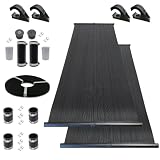
- 3. SolarPoolSupply DIY Solar Pool Heater Kit – The Strongest Full Collector System Here
- 4. Goplus 2.5 x 20 ft Solar Collector Panels – The Most Surface Area for a Mid-Range Budget
- 5. IRONMAX 2.5 x 20 ft Solar Pool Heater – A Solid Budget Mat for Smaller Pools
- 6. Solar Sun Rings 60-Inch 9-Pack – The Best Heat Retention Buy in the Lineup
- 7. Intex Solar Pool Water Heater Mat – The Easiest Low-Cost Way to Test Solar Heating
- 8. Doheny’s 2.5 x 20 ft Collector Kit – The Clearest Sizing Chart in the Category
- 9. VINGLI Domed Solar Pool Heater – The Fastest Install, if the Hoses Hold Up
- 10. GoFloats V2 Inflatable Solar Pool Heaters – The Cheapest Surface Coverage Option
- How Solar Pool Heaters Work
- Types of Solar Pool Heaters Compared
- How Many Solar Panels Do You Need
- Above-Ground vs In-Ground Pool Setups
- Installation, Mounting and Pump Integration
- Solar Blankets vs Panel Heaters
- Maintenance, Winterization and Common Problems
- Frequently Asked Questions
- Are solar panel pool heaters worth it?
- How many solar panels do you need to run a pool heater?
- Do solar pool heaters actually work?
- Which solar pool heater is the most efficient?
- How long does it take for a solar heater to heat a pool?
- How long do solar pool heaters last?
- What are the disadvantages of solar pool heaters?
- Final Verdict
Top 3 Solar Pool Heater Picks (October 2026)
The three products below cover the most common situations: an above-ground pool on a modest budget, an in-ground pool that needs a real collector array, and a large system for owners who want durability over everything else.

Bestway Solar Heating Pad
- Adds 5-9 F in sun
- Plumbs between pump and pool
- Adapters for 1.25 and 1.5 inch hose
- Works with 2200 gph and up
SolarPoolSupply DIY Panel Kit
- Complete mounting and plumbing kit
- Single-piece molded header
- 15-20 year service life

Intex Solar Pool Mat
- 11 square foot surface
- About 5-9 F in good weather
- Includes bypass valve
- Folds flat for storage
All 10 Solar Pool Heaters Reviewed in 2026
Every product we tested against the same criteria, ordered by how well each one fits a typical backyard setup. The comparison table below lists the format, the connection method and the collector size for each option so you can rule out mismatches before reading the full reviews.
| Product | Specs | Action |
|---|---|---|
| Bestway Solar-Powered Pool Heating Pad |
|
Check Latest Price |
 SolarPoolSupply Universal Replacement Panel 4 x 12 ft SolarPoolSupply Universal Replacement Panel 4 x 12 ft |
|
Check Latest Price |
| SolarPoolSupply DIY Solar Pool Heater Kit 2-4×12 |
|
Check Latest Price |
 Goplus 2.5 x 20 ft Solar Collector Panels Goplus 2.5 x 20 ft Solar Collector Panels |
|
Check Latest Price |
 IRONMAX 2.5 x 20 ft Solar Pool Heater IRONMAX 2.5 x 20 ft Solar Pool Heater |
|
Check Latest Price |
 Solar Sun Rings 60-Inch 9-Pack Solar Sun Rings 60-Inch 9-Pack |
|
Check Latest Price |
| Intex Solar Pool Water Heater Mat |
|
Check Latest Price |
 Doheny’s 2.5 x 20 ft Collector Kit Doheny’s 2.5 x 20 ft Collector Kit |
|
Check Latest Price |
 VINGLI Domed Solar Pool Heater VINGLI Domed Solar Pool Heater |
|
Check Latest Price |
 GoFloats V2 Inflatable Solar Pool Heaters GoFloats V2 Inflatable Solar Pool Heaters |
|
Check Latest Price |
1. Bestway Solar-Powered Pool Heating Pad – The Most Balanced Pick for Most Above-Ground Pools
Bestway | Solar-Powered Pool Heating Pad
Raises water 5-9 F in sun
Two hose outlets for inline hookup
Adapters for 1.25 and 1.5 inch hose
Weighs 13.53 pounds
Pros
- Adds measurable warmth in direct sun
- Connects straight between filter pump and pool
- Adapters included for two hose diameters
- Clear flow rate requirements for planning
Cons
- Some units arrive with pinholes that leak
- Included gaskets thin out when mats are chained
- Needs a genuinely strong pump to move water
- Extra fittings needed for garden hose setups
This is the pad we kept coming back to while working through the list. It is a black solar heating pad with two hose outlets, one to the filter pump and one back to the pool, and it measures 25.98 x 8.66 x 10.63 inches at 13.53 pounds. Nothing about it is exotic, which is exactly the point.
Bestway rates it at a 3-5 degree Celsius rise, or 5-9 F, in sunny conditions, and owners tend to describe the same thing in different words. The realistic outcome in good sun is a few degrees over an afternoon, and several people note that the effect becomes obvious the moment you add a cover to hold that warmth overnight.
Fit is the part to check before anything else. It works with cartridge filter pumps rated at 2,500 gallons per hour and above, and with sand filter pumps rated at 2,200 gallons per hour and above. Below those numbers the water sits in the pad instead of passing through it, and that is where most disappointed reviews come from.
Check your pump rating before you buy
The pump threshold is the single detail that decides whether this pad works for you. Many filter pumps sold with small above-ground pools fall short of the flow this pad wants, and no amount of sun fixes a circulation problem.
Plan to spend a few minutes at the pool filter with a garden hose and a bucket to time how long it takes to fill. If the math does not clear the manufacturer threshold, choose a smaller collector mat instead of a bigger one.
Where the weak points show up
A recurring complaint is pinholes in newly delivered units, along with gasket sets that are thin when you try to chain several pads together. Reviewers also note that connecting a standard garden hose takes extra fittings beyond what is in the box.
None of that is a deal breaker for a pad that fits your pump and your budget, but test the hoses with water before you bury them behind the pool wall. Two minutes of checking saves a wet lawn later.
2. SolarPoolSupply Universal Replacement Panel – The Drop-In Fix for a Failing Collector Run
Highest Performing Design – Universal Solar Pool Heater Panel Replacement – 15-20 Year Life Expectancy (4′ X 12′ / 2″ I.D. Header)
Universal fit for 2.0 inch ID headers
Replaces any hose and clamp panel
Zip-joints every 6 inches
15-20 year life expectancy
Pros
- Exact fit for most existing panel runs
- Plug-and-play swap with no plumbing changes
- Zip-joints absorb temperature stress
- Made in the U.S. with UV stabilizers
Cons
- Rubber connector boots not carried by big box stores
- Newer production panels use shorter connectors
- Product photos can show old connector style
This is not a heater kit. It is a single 4 x 12 foot panel that replaces a dead panel on an existing system, and if your collector run is already plumbed correctly it is the cheapest way to bring performance back rather than buying a whole new array.
The fit rule is specific. It replaces any panel that attaches with rubber hoses and hose clamps and uses a round 2.0 inch inside-diameter header manifold. It also combines a loose-tube and flat-plate absorber approach, with flexible zip-joints every 6 inches across the absorber surface to absorb the stress that temperature swings put on rigid tubing.
Owners replacing failed panels report an easy swap with no leaks, and a 4.6 rating across 117 reviews reflects that. The header is molded directly around the absorber tubes, which removes the internal flow barrier that slows water down in some designs.
Confirm the header diameter before ordering
Measure the outside of your existing header and check that it matches a 2.0 inch ID round manifold. If your current panels came from a different brand with a different header, this panel will not plumb into them without adapters you may not be able to source.
Check that the rest of your run is sound too. A new panel in a system with old, brittle hoses will just move the leak to a new place.
Where the friction shows up
Rubber connector boots are not carried by big-box hardware stores. Buyers also flag that newer panels from the same brand use shorter connectors than earlier production, and that listing photos can show the older connector style.
So have your measurements and your part numbers ready before you order, and expect a short trip to a pool supply store. That is the honest cost of this approach.
3. SolarPoolSupply DIY Solar Pool Heater Kit – The Strongest Full Collector System Here
Highest Performing Design – DIY Solar Pool Heater Kit – 15-20 Year Life Expectancy (2-4×12 / 2″ I.D. Header)
Complete kit with mounting hardware
Over-molded single-piece header
15-20 year service life
Expert install support included
Pros
- Highest rated kit in the group at 4.7
- Owners report gains of several degrees in days
- All hardware included so no parts hunting
- Panels uncurl flat and link to older systems
Cons
- High pump flow can dilute the return temperature
- Newer panels use shorter connectors than older ones
- Needs a roof rack or frame and basic plumbing skill
This is the kit we would build a proper in-ground system around. It is a 2-4×12 configuration from a brand with 50 or more kit combinations based on panel count and header diameter, and it arrives with the mounting hardware, panel connection hardware, a tie-down strap, and the supply and return plumbing parts.
What separates it from the mats and panels in this list is the header. It is a single over-molded piece with virtually no manufacturing variance, which matters because a header is the part that leaks when it is badly made. Combined with a molded-in header that eliminates flow barriers, it is the design we would trust to sit on a roof through a decade of seasons.
Owners of both above-ground and in-ground pools report steady heating gains of several degrees within days, plus a smooth self-install, which is why it holds the highest rating in the roundup at 4.7. Support is included, with unlimited access to installation specialists alongside a step-by-step manual.
Give it enough roof or rack area
This is a real array, not an accessory. The rule of thumb among pool owners is to cover 50 to 100 percent of the pool surface area with collector, and most people who regret a solar build regret buying too little.
Check that you have a mount point that faces the sun for most of the day, and that the tie-down plan holds in wind. A low fence in the wrong spot can shade the whole array by mid-afternoon.
Where the trade-offs show up
If your pump pushes a lot of water, the return can feel lukewarm because the water spends less time in the panel. Throttling the flow so water moves more slowly through the collectors is the fix owners describe, and it is a valve adjustment, not a rebuild.
The second point is physical. This needs a mounting frame or roof rack and some plumbing know-how, so it is a weekend project rather than an afternoon one.
One more practical note before you commit. The panels uncurl flat and can connect to older systems from the same brand, which makes this a reasonable upgrade path if you already own a basic setup and want to scale up rather than start over.
Because the kit includes the connection and plumbing parts, there is no guessing which fittings to buy. That alone removes the single most common reason DIY solar installs stall halfway.
One detail to plan around: the headers on newer panels use shorter connectors than earlier production from the same brand. If you are adding to an existing array, check the connector length before you order.
4. Goplus 2.5 x 20 ft Solar Collector Panels – The Most Surface Area for a Mid-Range Budget
Goplus 2.5FT x 10FT/ 20FT Solar Pool Heater for Above Ground Pool Inground Pools, Swimming Pool Solar Panel Heating System, Weatherproof Pool Warmer (2.5FT x 20FT)
20 ft x 2.5 ft collector area
Up to 10.8 F rise for pools to 6816 gallons
PE rated -20 C to 90 C
Weighs 25.3 pounds
Pros
- Large 20 ft collector area for the money
- Roll-up design stores flat between seasons
- End caps clamps hoses elbows and adapters included
- PE construction tolerates wide temperature ranges
Cons
- Mixed reports on real gain in cloudy weather
- Needs a 0.75 HP pump and extra plumbing fittings
- Higher share of one-star reviews than premium kits
This is two collector panels joined into a 20 foot run at 2.5 feet wide, and it weighs 25.3 pounds when rolled for storage. Goplus rates it for pools up to 6,816 gallons with a temperature rise of up to 10.8 F in good conditions.
That rating is worth qualifying. The material is PE rated from -20 C to 90 C, so it tolerates rooftop and cold-snap conditions far better than cheap PVC, and the roll-up design means it lies flat, mounts on the ground, an incline or a roof, and folds away for winter.
The connection kit is generous for the category. End caps, hose clamps, connector hoses, elbow connectors and hose adapters all come in the box, so the only thing you still need is a pump.
The pump requirement is not optional
Specification calls for a pump of at least 0.75 HP with pressure not exceeding 1.5 bar, or 21 PSI, and the pump is not included. Many above-ground pools have a smaller pump than that, so check your rating before this one goes in the cart.
If your pump sits under 0.75 HP, this style of panel is the wrong size for your plumbing. A smaller mat designed for low flow will do more for you.
Where the weak points show up
Roughly 13 percent of reviews are one star, and the pattern is consistent: people are happy with the surface area and the hardware, but question how much temperature actually moved in real conditions, particularly in cloudy weather.
That is an honest limit of any unglazed collector, not a defect in this panel. Cloud cover cuts the radiation the panel is built to capture, and no amount of surface area fixes that.
Buyers do like the flexibility of two connectable panels. If your pool is on the smaller side you can run one and add the second later rather than buying a full-length array you cannot mount.
Owners also single out the storage story. Rolling the collector up at the end of the season and putting it in a garage is a one-person job, and it is far simpler than draining and winterizing rigid panels.
5. IRONMAX 2.5 x 20 ft Solar Pool Heater – A Solid Budget Mat for Smaller Pools
IRONMAX 2.5 x 20 Ft Solar Pool Heater for Above Ground & Inground Pools
Two linked 2.5 x 10 ft panels
Up to 10.8 F for pools to 3408 gallons
PE tubes rated -1 F to 194 F
Needs 0.75 HP pump
Pros
- Large grid-tube collector area at an entry price
- Straightforward hookup with included hardware
- Roll-up panels store easily between seasons
- Three length options let you size to your pool
Cons
- Notable share of one-star ratings
- Inconsistent temperature rise reported in practice
- Pump and plumbing fittings not included
- Multiple panels needed for larger pools
The IRONMAX is a mat-format heater sold in three lengths, and the 2.5 x 20 foot version is the one to look at here. It arrives as two 2.5 x 10 foot panels that connect together, and the spec sheet rates it for pools up to 3,408 gallons with a rise of up to 10.8 F.
Compare that pool rating to the Goplus directly above it. Same stated temperature gain, roughly half the rated capacity, and the reason is that this unit is sold and judged as a smaller pool heater even when you string panels together.
Construction is black PE tubing rated from -1 F to 194 F, with rubber end caps, hose clamps, adapters and elbow connectors in the box. Like the Goplus it needs a minimum 0.75 HP pump with pressure under 21 PSI, and that pump is not included.
Sizing guidance is included, use it
IRONMAX ships with sizing guidance based on pool diameter and surface area, which is unusual at this price and genuinely useful. Use it before adding a second set of panels, because owners report that going bigger requires more panels than expected.
Measure your pool rather than guessing from the family photos. The difference between a 16 foot and a 20 foot pool is several thousand gallons, and the heating requirement moves with it.
Where the weak points show up
About 23 percent of reviews are one star, which is the second-highest share in this roundup. Buyers mostly like the size-to-price ratio and the connection hardware but report an inconsistent temperature rise, plus the need to source a separate pump.
Our read is that this is a sensible pick for a small or medium above-ground pool, and a poor choice for a large in-ground pool. Match the product to the volume and it behaves like the reviewers who rate it well.
One detail worth noting is the measurement. At 236.22 inches long by 29.53 inches wide and 1.61 inches thick, this is a flat sheet when unrolled, so it needs a clear, sunlit stretch of ground or deck roughly 20 feet long to lay out.
Owners also like that it stores rolled rather than rigid. Compared with a rigid panel array that has to be drained and stored upright, that is a meaningful difference in an ordinary backyard.
6. Solar Sun Rings 60-Inch 9-Pack – The Best Heat Retention Buy in the Lineup
Solar Sun Rings 60-Inch UV Resistant Solar Pool Heater │ Above Ground & Inground Pools & Spas │ Sunburst │ 9-Pack
Nine 60 inch floating rings
Two layers of UV resistant vinyl
Magnetic connection system
Weighs 24.5 pounds
Pros
- Doubles as a thermal blanket overnight
- Encapsulated magnets form a uniform surface
- Inner grid and grommets reduce sinking
- Lightweight and simple to place or remove
Cons
- Limited active heating in cool or cloudy weather
- Must not be stored in direct sunlight
- Rings can shift or separate in wind
With 3,153 reviews this is the second most examined product here, and the feedback makes the trade-off clear. Solar Sun Rings are nine 60 inch floating rings made of two layers of UV-resistant vinyl, held together by encapsulated magnets that form a continuous surface across the water.
What it does reliably is cut evaporation and hold warmth in after sunset. The safety design is thoughtful too. The rings separate on impact during an accidental fall, and a redesigned inner grid with drainage grommets keeps them from sinking.
As an active heater it is modest. Reviewers describe temperature gains as dependent on strong sun and wide coverage, and many note that in cool or cloudy weather it functions as a cover and little more.
Judge it as a cover first
If your pool loses heat mainly overnight, a floating cover addresses that directly and this product is genuinely good at it. Set your expectation at retention rather than active heating and the reviews make far more sense.
Coverage matters. Nine rings cover a wide above-ground pool fully and part of a larger in-ground pool, so count your surface area against the ring footprint before you decide.
Where the weak points show up
The most common negative is limited heating in cool or cloudy weather, which is a property of the design rather than a fault. The other recurring notes are practical: do not leave the rings sitting in direct sun when they are not on the water, because they can scorch whatever is underneath.
Rings can also separate and shift with wind or when a swimmer hits them. That is the safety design working as intended, but it does mean you may need to reposition them after busy afternoons.
Storage is simple. The whole set is lightweight at 24.5 pounds for nine rings, and you pull them out, roll or fold them, and put them away in minutes without draining anything.
Our view is that this belongs in a purchase alongside a panel system rather than instead of one. It is excellent at holding the heat you already made, and it does very little to make more.
7. Intex Solar Pool Water Heater Mat – The Easiest Low-Cost Way to Test Solar Heating
Intex Solar Pool Water Heater Mat for Above Ground Swimming Pools
11 square foot solar surface
About 5-9 F depending on weather
Needs pumps under 2000 GPH
Weighs 5.3 pounds
Pros
- Lowest entry point in the roundup
- Simple hose and valve hookup with two adapters
- Folds flat for compact off-season storage
- Two base sizes plus a 3-pack option
Cons
- Small 11 square foot surface limits gain
- High share of one-star ratings overall
- Needs pumps under 2000 GPH and direct sun
- Works best paired with a pool cover
The Intex mat has the largest review base in this roundup at 5,460 reviews, and it ranks second in Swimming Pool Heaters. It is also the smallest collector here at 47.25 x 47.25 x 0.5 inches and 5.3 pounds, with an 11 square foot surface.
Intex states a 5 to 9 degree rise depending on weather, and owners split cleanly into two camps. Those who pair it with a cover and get real sun report a few degrees; those who expected a pool heater report nothing happened. About 27 percent of reviews are one star, and that split explains the 3.2 average.
Its real value is that it is a low-stakes test. If you are unsure whether solar heat works for your pool and your climate, this tells you in a season for very little, with nothing to install beyond two hoses.
The pump limit runs the other way here
Unlike the panels and mats above, this one wants a weak pump. It is compatible with filter pumps up to 1/3 HP or a flow rate under 2,000 GPH, because a small mat simply cannot pass high flow efficiently.
That means if you upgrade to a bigger pump for a heat pump or a variable speed system later, this mat stops being the right accessory. Plan around that rather than buying it as a permanent fixture.
Where the weak points show up
Eleven square feet is not much collector. On a large pool the temperature move is diluted to the point that many owners notice nothing, and a single mat will not warm a 15 foot pool in a cool week.
Owners also stress the need for unobstructed direct sun and for pairing it with a cover. The mat makes heat, the cover keeps it, and without the second half the first half is wasted.
What you get in the box is unusually complete for this category: a 1.25 inch hose attachment point, a bypass valve, adaptor A and adaptor B for 1.50 inch hose, all in heavy-duty UV stabilized PVC. It suits above-ground pools up to 8,000 gallons and folds flat for winter storage.
Our advice for anyone starting out: buy this to learn whether solar suits your situation, then upgrade to a proper collector if it does. Owners who do that path rarely go back to the mat alone.
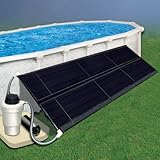
8. Doheny’s 2.5 x 20 ft Collector Kit – The Clearest Sizing Chart in the Category
Doheny’s Solar Heating Systems for Above Ground Swimming Pools (2.5′ x 20′ Collector Kit)
2.5 x 20 ft collector rated 40000 BTU
2-way diverter valve included
Mounting kit with straps and brackets
Weighs 24 pounds
Pros
- Sizing chart matches panels to pool diameter
- Owners report 5-10 degree gains after several hours
- Diverter valve gives on-off bypass control
- Panels can be expanded or replaced individually
Cons
- Not plug and play
- needs fittings and a rack
- PVC or flex piping not included
- Redesign made panels overlap and lie unevenly
Doheny’s is a long-established kit brand and the reason it earns a place here is documentation. It publishes a collector sizing chart by pool diameter and shape: a 12 to 15 foot round pool needs the 2.5 x 20 foot collector rated at 40,000 BTU, an 18 to 24 foot round pool needs the 5 x 20 rated at 80,000 BTU, and a 27 to 28 foot round pool needs both for 120,000 BTU.
That kind of explicit guidance removes the single most common complaint in this category. Owners report real gains of 5 to 10 degrees after several hours of good sun, and the 2-way diverter valve plumbs in as an on-off bypass so you can route water around the collectors when you are not heating.
Configurations come in 2.5 x 20, 5 x 20 and 5 x 10, and the roof or rack mounting kit includes 5 straps, 15 stainless steel brackets and 15 stainless steel screws.
Budget for the parts it leaves out
PVC or flex piping is not included, so you will need to source that and the fittings yourself. Plan the plumbing run before you unbox the collector, because a kit that arrives without pipe is a kit that stalls in the driveway.
The included diverter valve and spacer are worth using. Owners who plumb an automatic control report never having to think about the loop again.
Where the weak points show up
Two issues come up repeatedly. A redesign divided each 2.5 foot section into four, which made panels overlap and lie unevenly, and there are isolated reports of end caps that would not seal when rotated into place.
The recurring seasonal mistake is leaving water in the channels over winter. Trapped water freezes and cracks the channels, so drain the collector completely in the fall, every time.
9. VINGLI Domed Solar Pool Heater – The Fastest Install, if the Hoses Hold Up
VINGLI Solar Pool Heater Above Ground Domed Solar Powered Swimming Pool Heater Contour Pool Heating Coil (1 Pack)
Dome housing over a black heating coil
Foldable legs angle toward the sun
Pump pressure must stay under 0.8 bar
Weighs 15.87 pounds
Pros
- Installs in about five minutes
- Foldable legs let you aim the coil at the sun
- Compact footprint and simple storage
- Sold in 1
- 2 and 3 packs for scaling up
Cons
- Included hoses split or pinhole when heated
- Fittings sized for 1-1/4 inch hose only
- Slows flow which can reduce skimmer suction
- Clear instructions are lacking
The VINGLI is a plastic dome housing a black heating coil, measuring 23.23 x 23.23 x 11.42 inches at 15.87 pounds. It clamps to your existing hoses and the water is in the coil within a few minutes, which is the fastest install of anything in this roundup.
Two foldable legs let you prop the unit so the coil sits at the best angle to the sun, and the whole thing stores flat against a wall in winter. You can remove the protective cover to heat water faster, and units are available in 1, 2 and 3 packs if you want to chain them for better whole-pool heating.
One specification catches people out. Water pump pressure must not exceed 0.8 bar, so this is a low-flow device, and buyers with high-output pumps report that it slows water through the filter enough to reduce skimmer suction.
Expect to replace the supplied hoses
Roughly 29 percent of reviews are one star, and they describe the same specific problem: the supplied hoses split or develop pinholes once heated. Several owners substituted their own hose and report the coil itself works fine on a small pool.
Fittings are sized for 1-1/4 inch hose rather than 1-1/2 inch, and the instructions are thin. Check your hose diameter and your pump pressure before you start, and keep a spare hose on hand.
Where it fits well
For a small above-ground pool where a hose-and-clamp install is the whole goal, the coil design works. Owners report meaningful warming once the hose problem is solved with their own fittings.
The warranty is one year, which is the shortest in this roundup and the main reason we would not put this at the top of the list despite the quick setup.
It is also worth noting that the dome approach is one pool owners on forums consistently recommend for simplicity, because there is no rack, no roof work and no permanent plumbing to install.
That convenience is exactly what you are trading away if you choose this over a panel array. For a first small pool it is a reasonable trade. For a main in-ground pool it is not.
10. GoFloats V2 Inflatable Solar Pool Heaters – The Cheapest Surface Coverage Option
GoFloats V2 Inflatable Solar Pool Heaters for Affordable Pool Heating and Insulation – 3 Pack
Three 5 x 5 ft inflatable rings
25 square feet covered per ring
Size by dividing surface area by 30
Inflates in seconds with a shop vac
Pros
- V2 redesign inflates fast and lays flat
- Low-cost way to add surface insulation
- Easy to remove and store between seasons
- More durable than bubble style blankets
Cons
- High share of one-star ratings over wind and valves
- Blows out of the pool in modest wind unless tied down
- Traps debris that blocks skimmer cleaning
- Little effect without near-total coverage
The GoFloats V2 set is three inflatable rings, each 60 x 60 x 4.5 inches, so 5 x 5 feet each and 25 square feet of coverage. The whole pack weighs 3 pounds, which is the lightest item we looked at, and it inflates in seconds with a shop vacuum.
The sizing rule on the box is straightforward: divide your pool surface area by 30 to reach roughly 80 percent coverage. The V2 redesign does lay flatter than the original, and a thick outer perimeter minimizes overlap between rings so more of your surface is actually covered.
Like the Solar Sun Rings, this is a retention product that also collects a little sun heat during the day. Owners who reach 80 percent coverage report real retention and warming gains.
Coverage is the whole game here
Little effect without near-total surface coverage is the consistent finding. One three-pack on a large pool will not do much, and you will need two or more sets to reach the target percentage.
Tie the rings down in any forecast wind. Owners report them flipping out of the pool in modest conditions, and a ring landing on a vinyl liner or a dog is a real cost.
Where the weak points show up
About 28 percent of reviews are one star, concentrated on wind damage and inner rings losing air. Debris trapping that interferes with skimmer cleaning is also noted, which matters if you rely on your skimmer for leaf cleanup.
It is the lowest rated product in this roundup, and the reason is not that it does not work. It works as designed when you cover your pool, and falls short when you do not.
Owners do consider it more durable than bubble-wrap style solar blankets, which matters if you leave rings on a pool through a season of wind rather than putting them away nightly.
For inflatable or temporary pools that get drained and stored anyway, the pack is easy to move and easy to lose track of, so keep the rings with the pool gear rather than the pool box.
How Solar Pool Heaters Work
A solar pool heater has no moving parts of its own. It borrows the flow your filter pump already creates, routes that water through a black surface sitting in sunlight, and returns it to the pool a few degrees warmer. The only energy input is the sun.
The efficiency of the transfer comes down to three things: how much collector surface you have relative to your pool volume, how directly the sun hits it, and how quickly the water moves through it. Move water too fast and it spends too little time absorbing heat. Move it too slow and you get almost no circulation at all.
Flow control is where a differential temperature controller earns its place. It senses the temperature difference across the collector and diverts water back to the pool when the panels are cooler than the water, which stops the heater from becoming a cooler on a cloudy afternoon. Owners who install one report never thinking about the loop again.
Types of Solar Pool Heaters Compared
Flat-panel collectors with rigid headers, like the SolarPoolSupply products, run hottest because the absorber design pulls more heat from the sun per square foot. They are also the most permanent and the hardest to install without planning the plumbing first.
Roll-up mats and grid tubes, like the Goplus and IRONMAX panels, trade a little peak performance for storage flexibility. You can unroll them in spring, roll them up in fall, and they survive wide temperature ranges without cracking.
Dome units like the VINGLI sit in a compact footprint and install in minutes, but they work on a hose connection rather than a plumbed loop, which limits flow rate and scale. Floating rings are in a category of their own. They are covers first and heaters second, which is why two of the ten products in this roundup are rings rather than collectors.
How Many Solar Panels Do You Need
The working rule most pool owners land on is to cover between 50 and 100 percent of your pool surface area with collector. Northern climates and anyone hoping to extend the season into shoulder months need the upper end, because the sun angle is lower and the days are shorter.
Volume matters more than surface for temperature gain, so a deep pool heats more slowly than a shallow one of the same footprint. A 16 foot above-ground frame pool and a 20 foot in-ground pool may have similar square footage but very different gallon counts, and the deep one will take longer.
Forum advice across pool communities converges on one point. People who regret a solar build regret buying too few panels, not too many, and the marginal cost of adding a second collector later is far less than the cost of removing a bad array and starting over.
A practical starting sequence: measure your pool surface area, multiply by 0.5 for a modest season extension, and go higher if you live where winters are long. Then match that area to the panel sizes in this roundup before you buy anything.
Above-Ground vs In-Ground Pool Setups
Above-ground pools are the friendliest case. The pump requirement is lower, the panels can sit on a nearby patch of ground or on the pool wall, and a rolled mat stores flat in a shed when the season ends. Most of the low-flow products in this roundup are built for exactly this situation.
In-ground pools are where collector arrays pay off, because the surface area is large and the plumbing is permanent. Owners consistently prefer flat-panel roof or rack mounts for these setups, and they are the reason the SolarPoolSupply kit rates as well as it does.
The complication with any in-ground pool is the pump. A variable speed pump set to a high RPM can push more water than the panels absorb comfortably, which is why throttling flow comes up so often in reviews. Check your pump curve before ordering a large array.
Salt water and chlorine both attack rubber and plastic components over years. Chlorine-resistant and UV-stabilized materials are not a premium feature at this category; they are the difference between a five-season and a fifteen-season array.
Installation, Mounting and Pump Integration
Two mounting approaches cover almost every backyard. Roof mounting gets you the most direct sun and the highest collector temperature, but it adds real work and carries a leak risk over the pool. A ground rack or fence rack is easier, cooler, and more serviceable, at the cost of some efficiency.
On the plumbing side, every in-line installation runs the same path. A tee on the return line after the filter sends water to the collector, the collector returns to a second tee, and a bypass or diverter valve lets you isolate the loop when you are not heating. Kits that include the fittings and the valve save the most time here.
Pump capacity is the number that quietly decides whether an install performs. Panels want steady flow, not maximum flow, and a differential temperature controller handles the on-off decision automatically. A manual three-way valve works too, but owners report forgetting to set it, which sends warm pool water through panels that add nothing.
Budget a weekend. The physical mounting is a couple of hours with a ladder and a drill. The plumbing is the part that decides whether it is a one-person afternoon or a call to a plumber.
Solar Blankets vs Panel Heaters
These solve different problems and work best together. A panel heater makes warm water during the day. A blanket or ring cover keeps that warmth in overnight and stops wind-driven evaporation from stripping it out.
Compare the two ring products in this roundup directly. The Solar Sun Rings run a 3.4 rating across more than 3,000 reviews and cover a pool surface rather than heating water, while the GoFloats V2 pack is smaller and cheaper per ring but carries the highest one-star share at 28 percent.
If your main frustration is that the pool is warm at 5 pm and cold by morning, buy the cover first. If your frustration is that the water never gets warm in the first place, the cover will not solve that.
Maintenance, Winterization and Common Problems
Undersizing is the most common complaint across pool forums, and it is a design error rather than a defect. The second most common is a pump that cannot move enough water, which looks identical to a heater that does not work.
Leaking hose connections appear in reviews of the Bestway pad, the VINGLI dome and several budget mats, usually because a cheap hose softens under heat. Replacing the hose with a proper reinforced pool hose is a small job that resolves a large share of one-star reviews.
Freeze damage is the expensive mistake. Pool owners repeatedly warn that panels left full over winter crack when the trapped water freezes, so drain the collector completely in the fall, disconnect the hoses, and store roll-up panels rolled rather than folded.
UV degradation is what separates the tiers. Products made with UV-stabilized materials and claimed service lives of 15 to 20 years are built for full sun, while cheaper PVC mats tend to go cloudy and brittle within a few seasons.
Wind is the efficiency killer nobody accounts for. Panels lose heat quickly in moving air, and forum owners report that even a simple fence or shrub barrier on the prevailing wind side recovers a surprising amount of output. Secure every panel and strap you mount, because panels blowing off roofs is a real and repeated complaint.
Frequently Asked Questions
Are solar panel pool heaters worth it?
For most backyard pools, yes, if you size the collector to your surface area and keep the water moving through it. Panels add several degrees on a sunny day at zero running cost, but they do not heat a pool through a cold stretch on their own, and they cannot outrun the sun. Owners who combine collectors with a cover report the most consistent results, and the value case is strongest where the alternative is gas or electric heating used for a few extra months each year.
How many solar panels do you need to run a pool heater?
Cover roughly 50 to 100 percent of your pool surface area with collector. Use the lower end in hot climates for a season extension, and the upper end in northern climates or if you want shoulder months. Pool volume also matters, because a deeper pool dilutes the same collector area. Most owners who regret an undersized system say they should have bought more panels, and adding a collector later is easier than starting over.
Do solar pool heaters actually work?
They do, with conditions. Direct sun, adequate pump flow and enough collector area produce measurable gains, and owner reviews across the products in this roundup commonly report several degrees within days. The same reviews describe flat results when the pump is too small, the panels are shaded, or the pool is much larger than the collector can serve. Cloud cover is the hard limit, since these are unglazed collectors that depend on direct radiation.
Which solar pool heater is the most efficient?
Flat-panel collectors with molded headers are the most efficient per square foot, and the SolarPoolSupply products in this roundup use that design with UV-stabilized materials and stated service lives of 15 to 20 years. Among the mat-style options, larger collector area beats smaller area, so a 20 foot run outperforms a 10 foot run on the same pool. Efficiency also depends heavily on flow rate, since water moving too fast leaves the panel before it absorbs much heat.
How long does it take for a solar heater to heat a pool?
Expect a rise of a few degrees in a sunny day rather than a full transformation, and think in days rather than hours. Owners report steady gains of several degrees within the first few days of a good week, and 5 to 10 degree gains from mid-size collector kits after several hours of strong sun. Small mats on large pools may show almost nothing. Adding a cover is what converts a day’s gain into a season of comfortable water.
How long do solar pool heaters last?
It depends on the material tier. Products with UV-stabilized construction and molded headers, such as the SolarPoolSupply line, are built for 15 to 20 years, and pool owners consistently praise their durability. Budget PVC mats and domes commonly last 2 to 5 seasons, with UV degradation and freeze damage as the usual failure causes. Draining panels completely before winter is the single cheapest way to add years.
What are the disadvantages of solar pool heaters?
The main drawbacks are speed, dependence on weather and a real installation learning curve. They heat slowly compared with gas or electric equipment, they do nothing in cloudy conditions, and they need a pump with enough flow to move water through the collectors. Panels also take up yard, deck or roof space, and flexible mats need to be drained and stored before freezing weather. The upside is that there is no fuel, no element and no monthly operating bill.
Final Verdict
The Bestway solar heating pad takes our pick for the best solar pool heaters for backyard pools because it balances rating and review volume better than anything else here, ships with adapters for the two most common hose sizes, and states its pump requirements clearly enough that you can rule it in or out in a minute. If your pump clears 2,200 gallons per hour, it will work.
For an in-ground pool with real mounting space, step up to the SolarPoolSupply DIY kit, which is the most capable collector array in the group and the one most likely to still be running in fifteen years. For a large above-ground pool on a moderate budget, the Goplus 20 foot collector is the sensible middle.
Add a cover to whichever system you choose. Across owner reviews, the cover is what turns a warm afternoon into a usable evening, and it costs a fraction of what an undersized collector array costs to fix later. While you are planning the yard work, our best archery targets for backyard and best telescopes for backyard astronomy guides cover the other two things people put in a yard they use all year.
This ranking reflects the product lineup as of 2026, and the collector area, pump thresholds and durability tiers described here are the details that actually decide whether a solar heater works in your specific backyard.